
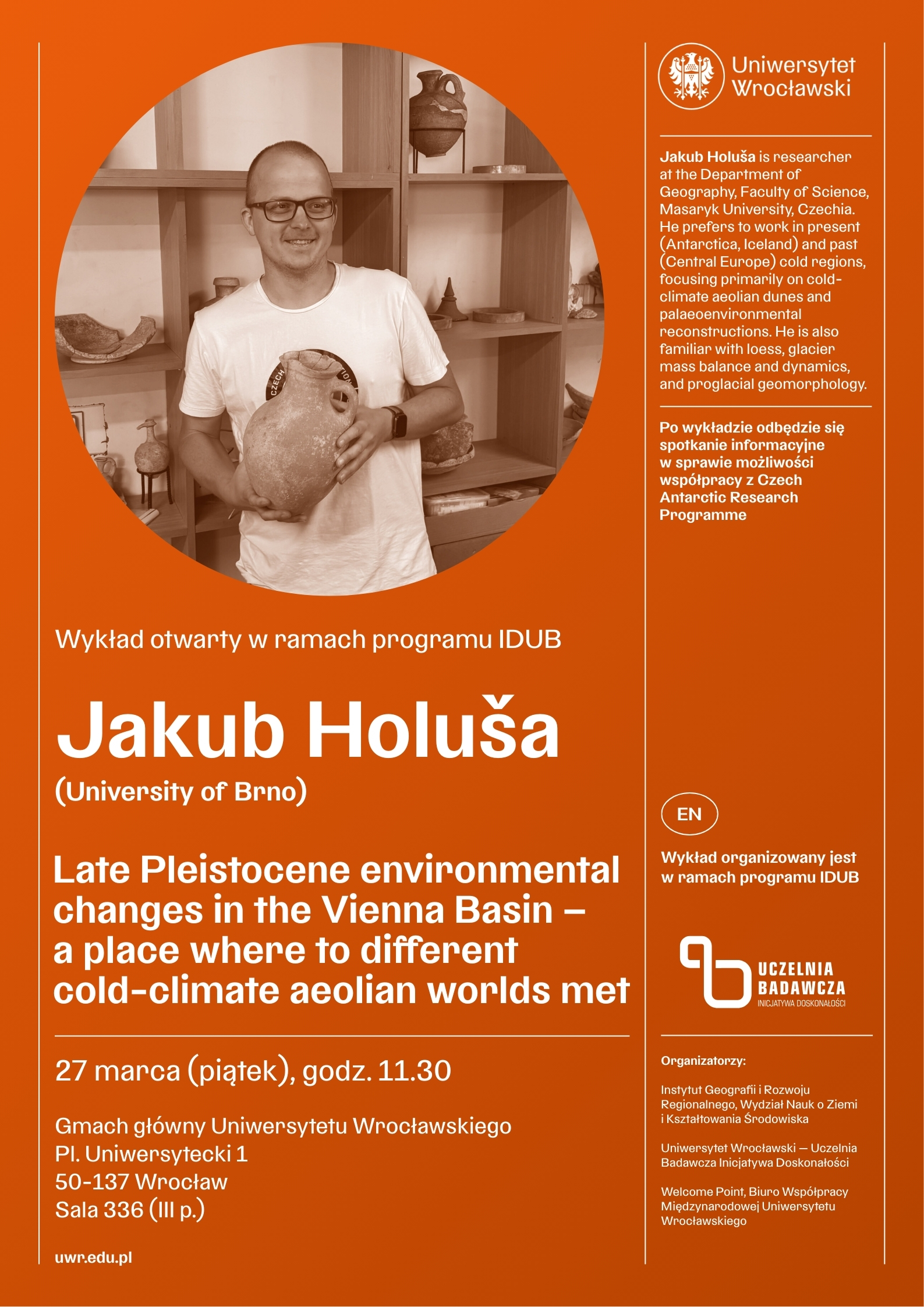
Zapraszamy na wykład Jakuba Holuša (Uniwersytet Masaryka w Brnie) w ramach programu „profesorów wizytujących” projektu IDUB
Szanowni Państwo,
w imieniu dr Michała Łopucha, reprezentującego Zakład Geografii Fizycznej Wydziału Nauk o Ziemi i Kształtowania Środowiska, zapraszamy na wykład Jakuba Holuša (Uniwersytet Masaryka w Brnie), wizytującego Uniwersytet Wrocławski w ramach programu „profesorów wizytujących” projektu IDUB.
Prelegent: Jakub Holuša (University of Brno)
Data: 27.03 (piątek), g. 11:30
Gdzie: s. 336, Gmach Główny (III p.)
Tytuł wykładu: Late Pleistocene environmental changes in the Vienna Basin – a place where to different cold-climate aeolian worlds met
Abstrakt wystąpienia: Vienna Basin represents the northwesternmost part of the Carpathian Basin. Aeolian sand accumulations are therefore spread over 1300 km2 in the Vienna Basin, covering >10% of its area. The northernmost part of the Vienna Basin served as a convergence zone for at least two atmospheric circulation patterns. Whilst the wind pattern (westerlies) in most of the Vienna Basin has remained unchanged at least since the Last Glacial Maximum, some of the dunes were clearly formed by winds blowing from north, which were defined as katabatic winds propagating from the Scandinavian Ice Sheet. These winds ceased to exist once the ice sheet retreated further north (probably during the Oldest Dryas). OSL dating results obtained from the two largest dune fields in the Vienna Basin show episodical aeolian activity between 26 ± 2 ka and 13 ± 2 ka, peaking during the Oldest Dryas (16.5 to 14.7 ka). This chronology is in accordance with a pattern described in the rest of the Carpathian Basin.
Bio: Jakub Holuša is researcher at the Department of Geography, Faculty of Science, Masaryk University, Czechia. He prefers to work in present (Antarctica, Iceland) and past (Central Europe) cold regions, focusing primarily on cold-climate aeolian dunes and palaeoenvironmental reconstructions. He is also familiar with loess, glacier mass balance and dynamics, and proglacial geomorphology. He has established a close international cooperation with the scientists from Central Europe, Israel and USA, resulting in academic stays in Poland and Israel and publishing his research in nine articles in journals indexed in Web of Science.
Dodatkowa infromacja: Po wykładzie odbędzie się spotkanie informacyjne w sprawie możliwości współpracy z Czech Antarctic Research Programme


